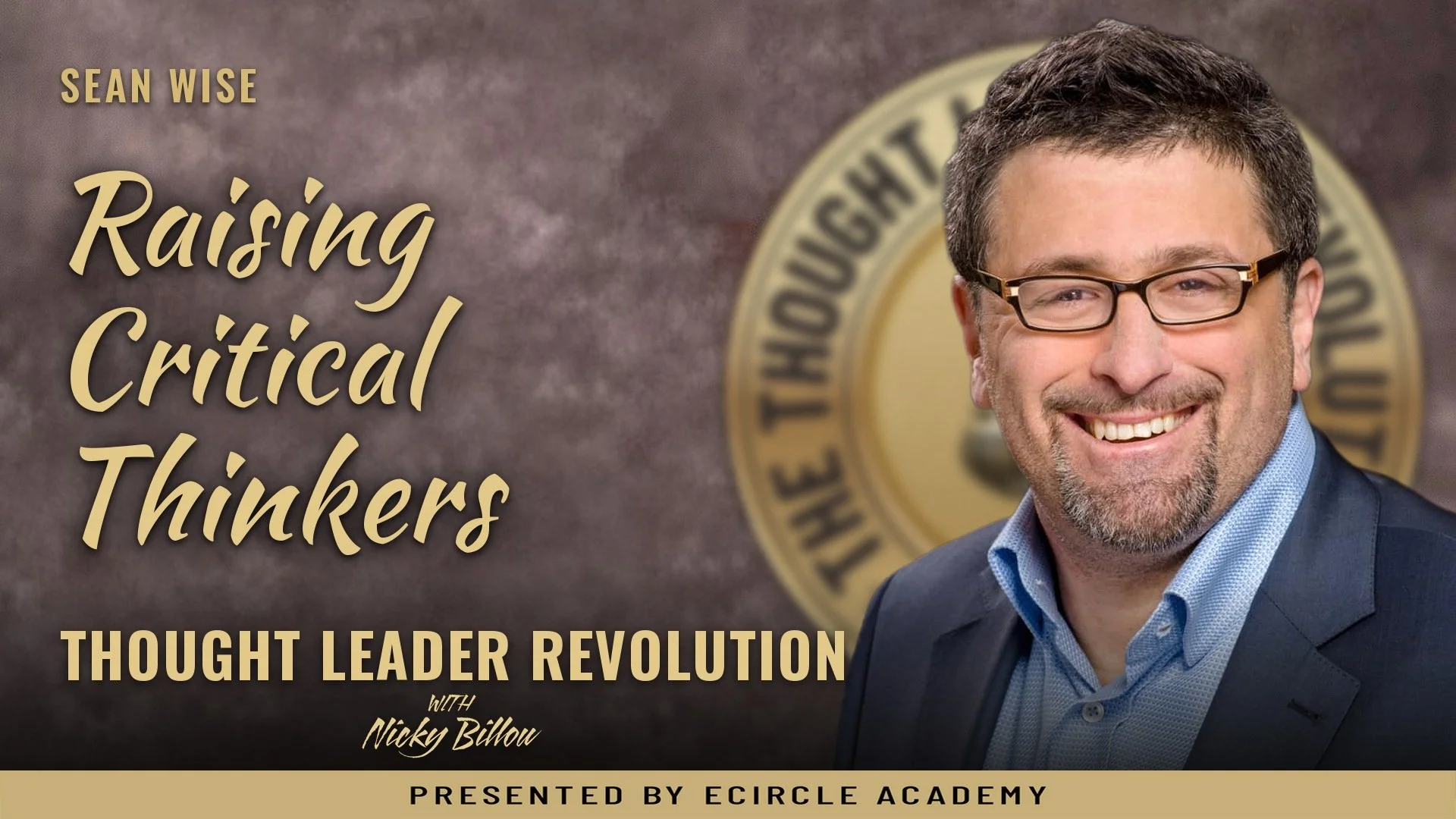
EP834: Sean Wise - How To Turn The Next Generation Into Critical Thinkers & Entrepreneurs
EP833: Sean Wise - How To Turn The Next Generation Into Critical Thinkers & Entrepreneurs
Nicky Billou

"If you don't like being managed by other people, then don't be managed by other people." — Sean Wise

Sean Wise — venture capitalist, TMU professor, and Dragon's Den veteran — brings a rare combination of street-level entrepreneurial experience and serious academic depth to a conversation that covers agentic AI, startup economics, and why the window for shaping entrepreneurs may close before high school.

Sean's origin story alone is worth the listen. Fired from McDonald's at 12 for pushing back on food waste policies, he went home to parents who told him the obvious: build something of your own. By 13, he was Sean the Clown, making tens of thousands of dollars at yuppie birthday parties in 1983, learning that hourly work doesn't scale before he had words for the concept. That instinct carried him through two decades of venture capital, roughly $1.2 billion in capital deployed, a few unicorns, and multiple companies of his own — some successful, some not.

The AI portion of this conversation is some of the clearest thinking you'll hear on the subject. Sean draws a clean line between using AI to build your startup and building an AI startup, explains why agentic AI is fundamentally different from earlier chatbots — it has digital hands and it never sleeps — and makes a sharp case for why the next era of competitive advantage belongs to domain expertise and human connection, not code. The SWIPE framework (steal with integrity and pride everywhere) is a method he has used since he was 16 and still teaches today.

Sean also shares his current work with Junior Achievement Canada, expanding a program that brings entrepreneurial thinking to grade 6, 7, and 8 students nationwide — because the research suggests the habits that shape ambition and agency are largely formed before age 14.

Sean closes with three concrete steps listeners can start applying today.

Expert action steps:
1. Use the SWIPE method — steal with integrity and pride everywhere. Find the best practitioners in the skill you want to build and model what they do. Mirror neurons are real; deliberate imitation is how mastery begins.
2. Double down on the few things you do exceptionally well and outsource everything else. The less time you spend on tasks you are mediocre at, the more capacity you have for the work that actually generates value.
3. Never stop learning. Commit to picking up something new every day. Sustained curiosity, compounded over time, is what creates genuine financial independence — not a single breakthrough moment.

Learn more & connect
Sean Wise at TMU: https://www.torontomu.ca/tedrogersschool/business-management/majors/entrepreneurship/faculty/sean-wise/

Resources mentioned:
Bordi (AI-powered LinkedIn networking tool): https://www.bordi.ai
Junior Achievement Canada: https://www.jacanada.org
Base44 (vibe coding / app builder): https://www.base44.com
Grok / xAI Agentic AI: https://www.x.ai

Visit https://www.eCircleAcademy.com and book a success call with Nicky to take your practice to the next level.
Chris Rodd
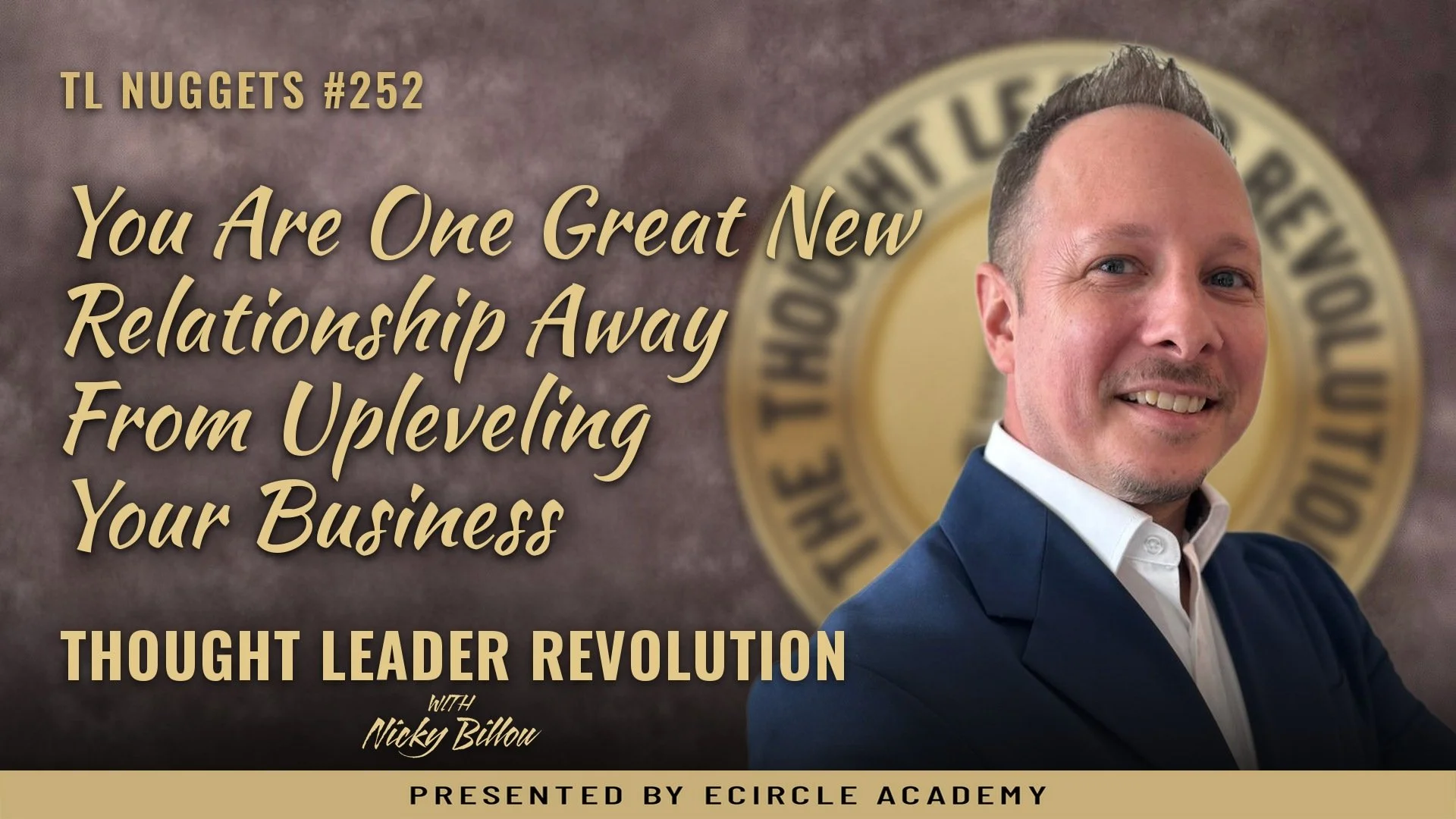
EP833: TL Nuggets #252 - You Are One Great New Relationship Away From Upleveling Your Business
Nicky Billou

"What it takes people at traditional conferences up to a year to reach a certain level of trust with someone — we can do it in 7 days." — Mario Lamarre

Most networking produces surface-level connections that fade within weeks. Mario Lamarre decided to solve that problem by changing the environment entirely. His Real Estate Investor Summit at Sea brings entrepreneurs and investors together on a cruise ship for seven to eight days — and what gets built in that time routinely takes a year to form in conventional settings.

Recorded live at the Expand Conference in Calgary, Nicky and Mario trace the logic behind immersive relationship events: the know, like, trust sequence that every business relationship depends on accelerates dramatically when people share meals, evenings, and unguarded conversations over consecutive days. The deals come later — but only because the trust came first.

The conversation also turns to the other side of the equation. Relationships open doors; sales close them. Nicky makes the case that sales is oxygen to a business — not a task to tick off, but a discipline to practice daily. He describes the Calling Madness sessions at eCircle Academy: an hour a day, five days a week, where members get on Zoom together and make their calls, then debrief as a group. It is accountability and skill-building compressed into one structure.

Mario brings both perspectives to the table — as someone who creates the environments where great business relationships are born, and as someone who has worked inside eCircle Academy to sharpen the sales edge that makes those relationships pay off.

Upcoming events — Real Estate Investor Summit at Sea:
February 20–27, 2027 — departing Miami
August 15–22, 2027 — departing Rome

Learn more & connect
Contact Mario Lamarre directly for registration details on the Real Estate Investor Summit at Sea.
eCircle Academy — https://www.eCircleAcademy.com

Resources mentioned:
eCircle Academy — https://www.eCircleAcademy.com
Real Estate Investor Summit at Sea — contact Mario Lamarre for event details
Expand Conference, Calgary — entrepreneurship and real estate investor event

Visit https://www.eCircleAcademy.com and book a success call with Nicky to take your practice to the next level.
Chris Rodd
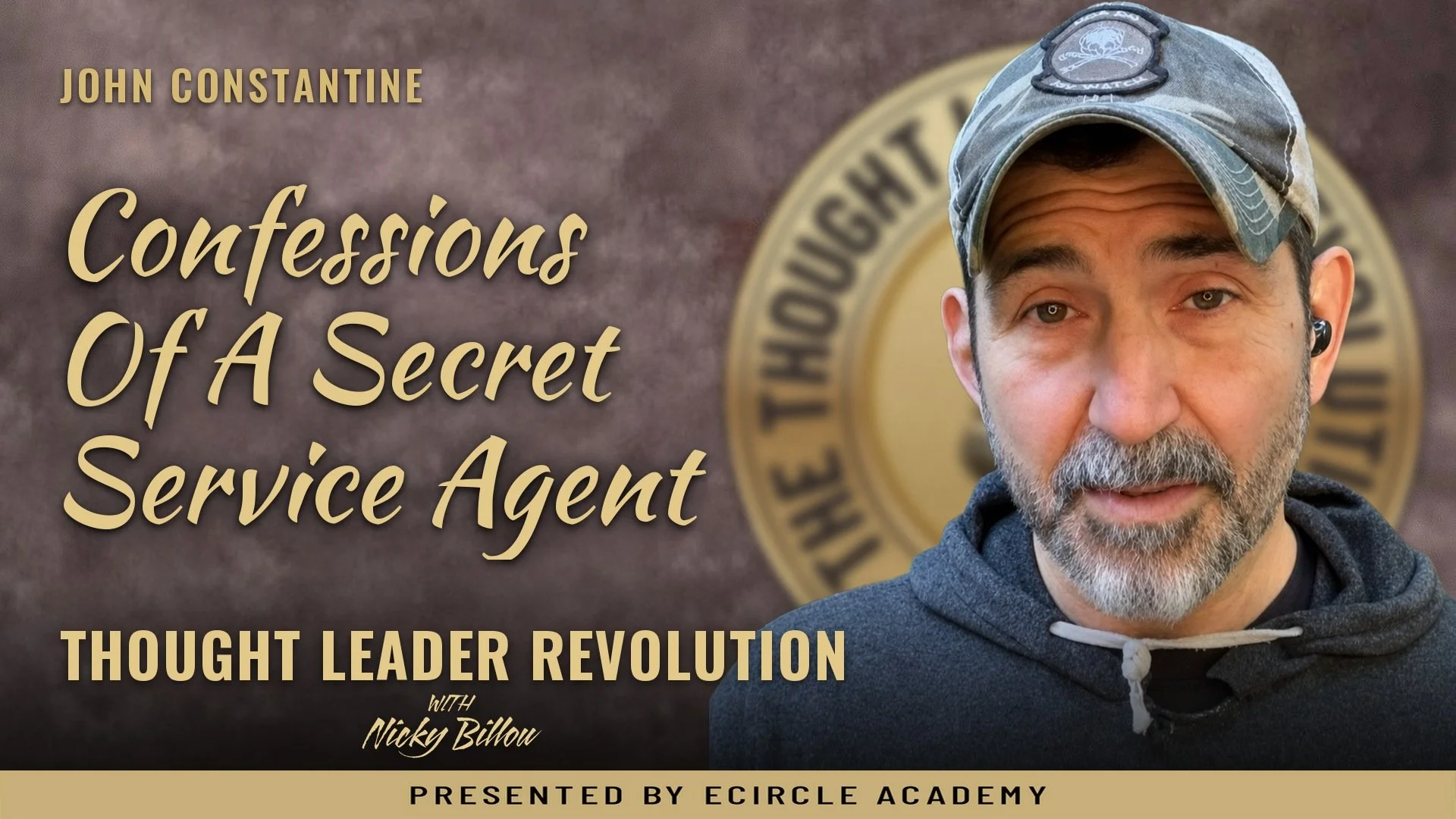
EP832: John Constantine - Confessions Of A Former US Secret Service Agent
Nicky Billou

"You will be discouraged. At some point, you will feel as if, why am I doing this? But stop for a second — if you have put in the work, if you are disciplined and have a routine, and you stop and look back and see how far you've come, you will be successful at some point." — John Constantine

John Constantine spent 23 years inside the United States Secret Service — 15 of them in special operations on the Counter Assault Team, the unit tasked with counter-ambushing anyone who moves on a protected principal. He served across four presidential administrations, ran operations at two United Nations General Assemblies, and spent the better part of two decades in tactical gear carrying weapons he still cannot fully describe in public. He retired in 2025 and has since started talking.

The centrepiece of this conversation is Butler, Pennsylvania. Constantine does not hedge. The planning failed. The communication failed — more than 100 transmissions either ignored or not received in a unit where communication is the single non-negotiable. A civilian named Corey Comparatore was killed. Constantine is honest about the institutional pressures that contributed to that day, equally honest about the agents who showed up and tried to do their jobs, and firm that none of the context amounts to an excuse. It is the kind of account that only comes from someone who knows exactly what good looks like.

He also talks about identity — what happens when a career built entirely around one elite role comes to an end, and the book he wrote to work through it. Hallways and Stairwells asks a simple question on its back cover: who do we become in the places where no one is watching? The answer, Constantine argues, is the only leadership credential that actually matters.

Constantine closes with three concrete pieces of advice drawn straight from the mat, the motorcade, and the hard road of starting over.

Expert action steps:
1. Set your goal before anything else. Without a clear target, even strong work ethic scatters — like a lamp lighting everywhere instead of a laser pointing somewhere.
2. Be prepared to fail, and keep showing up anyway. Constantine spent three years earning his purple belt in jiu-jitsu by tapping out repeatedly. Humility is not the opposite of success — it is a prerequisite.
3. Build a daily routine and measure your progress over time. When discouragement hits, the routine holds you. And looking back at how far you have come gives you the fuel to keep going.

Learn more & connect
John Constantine on Instagram: https://www.instagram.com/john.constantineonezero
Hallways and Stairwells (book): https://www.amazon.com/dp/1964508630

Resources mentioned:
Hallways and Stairwells: Unhealthy Egos, Broken Identities, and Our Journey for Self-Worth by John Constantine
The Communist Manifesto by Karl Marx and Friedrich Engels
Rules for Radicals by Saul Alinsky
Discourses on Livy by Niccolo Machiavelli

Visit https://www.eCircleAcademy.com and book a success call with Nicky to take your practice to the next level.
Chris Rodd
EP831: Eric Koester - Limited Series 2 of 4 - The Grit - Growth Flywheel
Nicky Billou

"Exponential growth happens when your self-belief and someone else's belief in you start to interact. That's not an accident — that's the flywheel." — Eric Koester

Eric Koester is back for the second of four conversations with Nicky on the Grit-Growth Flywheel — and this one goes deep into the mechanics of what actually creates an inflection point in someone's career.

Nicky shares the story behind his own biggest breakthrough: sitting across from a coach who charged $5,000 upfront with no refunds, having almost no money, and giving himself two days to figure it out. Eric uses that story as a live case study — walking through the exact science of why that moment produced exponential growth, and why most people who admire that kind of story still don't know how to replicate it.

The answer comes down to two forces working together. A growth mindset — the internal shift in what you believe is possible for you — gets unlocked when you accomplish something you genuinely doubted you could do. Grit — as defined by Angela Duckworth — gets unlocked in the eyes of others when you demonstrate that you did it. When those two perceptions reinforce each other, the flywheel begins to spin. Neither element alone is enough.

The conversation turns practical in the second half, as Nicky identifies a current stretch goal and Eric helps him deconstruct it using the same model. The result is part framework session, part live coaching — and a clear, repeatable template for designing your next inflection point rather than waiting for one to find you.

Learn more & connect
Eric Koester — https://www.erickoester.com

Resources mentioned:
Angela Duckworth, Grit: The Power of Passion and Perseverance — https://www.angeladuckworth.com
Carol Dweck, Mindset: The New Psychology of Success — https://www.mindsetonline.com
CreateSpace (Amazon KDP) — https://kdp.amazon.com
YPO (Young Presidents' Organization) — https://www.ypo.org
EO (Entrepreneurs' Organization) — https://www.eonetwork.org

Visit https://www.eCircleAcademy.com and book a success call with Nicky to take your practice to the next level.
Chris Rodd
EP830: Caleb Guilliams - You Are Your Greatest Asset
Nicky Billou

"You are your greatest asset — and you don't show up anywhere on a balance sheet." — Caleb Guilliams

Caleb Guilliams started his financial services company at 21 with no clients, no safety net, and a domain name he literally couldn't afford. He'd been gutting chickens at 15, running a bank's entire investment department at 19, and had spent years quietly building the kind of relationship network most people twice his age haven't managed. Today, BetterWealth serves clients in all 50 states, and Caleb's annual industry event is on track to draw 500 people — all of it built without corporate backing, and almost entirely on relationship capital.

What makes this conversation worth your time is the idea at the centre of it: you are your greatest asset, and you never appear on any balance sheet. Caleb makes the case that most people invest in the measurable things — cash, property, stocks — while systematically underinvesting in the two things that actually generate future value: their skill sets and their people. He explains why relationships follow the same buy-low, sell-high logic as any other asset class, and why the best time to build them is before you need them.

He also talks honestly about what it costs to bet on yourself young — the fear of failure in front of people who know you, the ego you have to set aside, and the way imagining your 85-year-old self tends to cut through all of it. Caleb is the kind of guest who says quiet things with enormous weight, and this one is worth a full listen.

Caleb closes with three concrete steps anyone can start today — no financial expertise required.

Expert Action Steps: 1. Audit yourself across four areas: your time, your relationships, your skill sets, and your financial position. You can't improve what you haven't measured. 2. Write down your goals, mission, and vision. People without a clear destination can't move efficiently — they're walking when they could be flying. 3. Pick one action item in each of those four areas that moves you closest to your vision. Don't try to eat the elephant overnight; find the one lever in each domain and pull it.

Learn more & connect
YouTube: https://www.youtube.com/@BetterWealth
Email: caleb@betterwealth.com

Resources mentioned:
The Richest Man in Babylon — George S. Clason
Good to Great — Jim Collins
Giftology — John Ruhlin (https://www.giftology.com)
Cameron Herold's TED Talk, "Let's Raise Kids to Be Entrepreneurs" — https://www.ted.com/talks/cameron_herold_let_s_raise_kids_to_be_entrepreneurs
BetterWealth — https://www.betterwealth.com

Visit https://www.eCircleAcademy.com and book a success call with Nicky to take your practice to the next level.
Chris Rodd
EP829: TL Nuggets #251 - From Scared To Sold
Nicky Billou

"This is what nobody in business wants to admit out loud. There's a fear behind the ask. Good people freeze at every step of the sales process, from the first reach out all the way to naming the price and asking for money." — Nicky Billou

If you've ever gone soft on the price, avoided the follow-up, or talked yourself out of making the call altogether — this one is for you. Not because you need a better script, but because the problem is almost certainly not what you think it is.

I call it sales hesitancy. It's a stress response, not a skill gap. And it shows up the same way for a lot of people: rushing through pricing, skipping the questions that would actually uncover a prospect's real pain, discounting when there's no reason to, and dodging follow-up to avoid the discomfort of the ask. Prospects pick it up immediately — and they don't interpret it as nerves. They interpret it as doubt about whether the offer is worth it.

The fix isn't to rehearse harder. You can't outscript a nervous system. At eCircle, I've learned to calm the body first and teach the skills second — because skills only stick when the threat response isn't running the show.

I close with four concrete steps you can start applying before your next sales conversation — and a story about a tax accountant who went from dreading calls to booking three sales appointments in under twenty minutes. Same offer, same phone, different state.

Learn more & connect
https://www.eCircleAcademy.com/appointment

Resources mentioned:
eCircle Academy — https://www.eCircleAcademy.com

Visit https://www.eCircleAcademy.com and book a success call with Nicky to take your practice to the next level.
Chris Rodd
EP828: Eric Koester - Limited Series 1 of 4 - The Grit - Growth Flywheel
Nicky Billou

"Stop posting more dancing TikToks and start focusing on building more collaborative demonstrable projects. That's what leads to true thought leadership." — Eric Koester

Eric Koester is back for the first of a four-part limited series with Nicky — and this one picks up where their original conversation left off, going deeper on one of the most practically useful frameworks to come out of entrepreneurship research in years: the Grit Growth Flywheel.

Koester has studied the inflection trajectories of over 6,000 people who demonstrably bent the curve in their careers — people who made the Forbes 30 Under 30 list, launched category-defining companies, or built thought leadership platforms that took off. What he found was not what most people expect. It wasn't the schools they attended, the networks they inherited, or the timing of the market. It was a specific kind of project — public, finishable, learning-oriented, and collaborative — that reliably created what Koester calls an inflection point.

The Sheryl Sandberg story is one of the episode's most vivid illustrations: an ambitious Harvard undergrad launches an informal speaker series to help women break into government and economics, catches the attention of Larry Summers, becomes his research assistant and eventually his chief of staff at the U.S. Treasury, and is later tapped by Mark Zuckerberg to run Facebook. A few hours a month. One project. A flywheel that changed everything.

Nicky maps his own journey onto the framework in real time — the 30-page book he used like a business card to launch his coaching practice, the offhand mastermind idea that turned into the Entrepreneur Circle, and the men's dinner series he is currently building — and Koester works through each one, showing exactly what makes a project flywheel-worthy and what keeps most people stuck on the hamster wheel instead.

Learn more & connect
Eric Koester — https://www.erickoester.com

Resources mentioned:
No More Mr. Nice Guy by Robert Glover — https://www.amazon.com/dp/0762415339
Atomic Habits by James Clear — https://www.amazon.com/dp/0735211299
The 4-Hour Workweek by Tim Ferriss — https://www.amazon.com/dp/0307465357
Lean In by Sheryl Sandberg — https://www.amazon.com/dp/0385349947

Visit https://www.eCircleAcademy.com and book a success call with Nicky to take your practice to the next level.
Chris Rodd
EP827: TL Nuggets #250 - Structure Of A Sales Call
Nicky Billou

"Without you understanding the truth, you're in deep, deep, deep doo-doo when it comes to selling and growing your business." — Nicky Billou

Most coaches and consultants lose sales not because their offer is flawed or their price is too high — but because they walk into a sales conversation without a structure. Fear fills that vacuum fast.

I break down the exact framework my great friend and mentor Marc Von Musser taught me — the sequence I have used in every high-value sales conversation since. It starts before you even pick up the phone: a magic minute of mental visualization, a peak state ritual to get your energy right, and an intentional environment set up for focus and presence.

Then comes the call itself. Rapport first, always. Then a clear framing of how the conversation will go. Then a deep excavation of the prospect's problem and the emotional cost of leaving it unsolved. That clarity creates genuine urgency — no manufactured pressure needed. From there, you qualify: not every prospect gets to work with you. Decisive? Committed? Coachable? Resourceful? Once you have confirmed the fit, you paint a high-level picture of the solution, name your price with confidence, and ask for the decision.

Simple. Sequential. Repeatable. This is a framework you can use on your very next call.

Learn more & connect
https://www.eCircleAcademy.com

Resources mentioned:
Marc Von Musser — heart-driven sales expert and Nicky's sales mentor
Plaud — AI note-taking tool: https://www.plaud.ai
Tony Robbins — referenced for peak state methodology: https://www.tonyrobbins.com

Visit https://www.eCircleAcademy.com and book a success call with Nicky to take your practice to the next level.
Chris Rodd
EP826: Jordan Adler - Beach Money
Nicky Billou

"I was a pilot before I could fly. I envisioned myself as a pilot in the present tense. I was a successful business builder with a large residual income before I had a check." — Jordan Adler

Jordan Adler is the author of Beach Money — one of the most widely quoted books on passive income and entrepreneurial mindset — and this conversation earns the book's reputation. Jordan spent ten years across eleven different network marketing companies without making a single dollar. At 34, he was living in an enclosed garage, carrying $36,000 in debt on 22 credit cards. His twelfth attempt became the company he made millions with. What changed wasn't the opportunity. It was the decision.

The sharpest idea in this conversation is one Jordan has been teaching for years: believing and doubting are two sides of the same coin — you can flip between them forever. Knowing is different. When you know, doubt doesn't get purchase. He maps this across three zones — doubt, belief, and knowing — and makes the case that the rare people who seem to create effortlessly are simply operating from the third one. He also draws a clear line between motivation and commitment. Motivation fluctuates. Commitment doesn't. You don't raise your kids based on whether you feel like it — and you shouldn't build your business that way either.

Two extended stories bring this to life: his years as a hang glider pilot and his more recent journey to earning a helicopter pilot's license — a process that cost $100,000, took far longer than anticipated, and produced failure and self-doubt at every stage. And then there's the hummingbird — a creature spending two hours destroying itself against a window when the open door was ten feet behind it. It's one of the better entrepreneurial metaphors you'll hear.

Jordan closes with four concrete action steps — grounded, specific, and the kind that compound quietly over a lifetime.

Expert Action Steps:

1. Save 10% of everything you earn and invest it conservatively for the long term — no exceptions, no matter the amount. Compounding rewards consistency, not size.

2. Protect and expand your dream. If you've lost the ability to envision what you want, surround yourself with dreamers and readers until it comes back.

3. Do the work. You find what works and what doesn't only by putting in the hours — there is no shortcut to that data.

4. See it through. Don't stop until you've accomplished what you set out to accomplish — not when it gets hard, and not on a bad day.

Learn more & connect
Instagram: https://www.instagram.com/beachmoneyjordan
Website: https://jordanadler.com

Resources mentioned:
Beach Money by Jordan Adler
The 10 Napkin Presentations by Don Failla
The Richest Man in Babylon by George S. Clason

Visit https://www.eCircleAcademy.com and book a success call with Nicky to take your practice to the next level.

Chris Rodd
EP825: TL Nuggets #249 - Additional Thoughts On Serving The Decided
Nicky Billou

"The decided are action takers. The undecided are not." — Nicky Billou

Last week's episode on serving the decided generated a clear and consistent question: how do you actually find them? This episode answers that directly.

The decided aren't people who merely recognize they have a problem — they're people who have already made an internal commitment to do something about it. They show up differently. They engage differently. And the environments they tend to appear in are different from the ones that attract wishful thinkers and chronic complainers.

One of the most effective strategies right now for getting in front of the decided is the live, in-person business mastermind dinner. Curated, commitment-requiring, and inherently self-selecting — these events attract business owners who are already oriented toward growth and action. The conversation that happens in the room and the follow-up that comes after it are where you find out exactly who is ready to move.

Here are three steps to start putting this into practice: 1. Host or attend a live in-person business mastermind dinner. Curated rooms of growth-oriented business owners are one of the fastest ways to find people who are already decided and ready to act. 2. Follow up every in-person connection. A conversation over dinner is just the start — schedule the one-on-one call, Zoom, or phone meeting where you actually discover whether someone is decided. 3. Stop trying to convert the undecided. Notice when a prospect is complaining rather than committing, and redirect your energy toward people who have already made the internal decision to change.

Learn more & connect
https://www.eCircleAcademy.com

Resources mentioned:
EP823: TL Nuggets #248 - Serve The Decided (the previous episode) — https://www.thethoughtleaderrevolution.com/episodes/823
eCircle Academy — https://www.eCircleAcademy.com

Visit https://www.eCircleAcademy.com and book a success call with Nicky to take your practice to the next level.

Chris Rodd