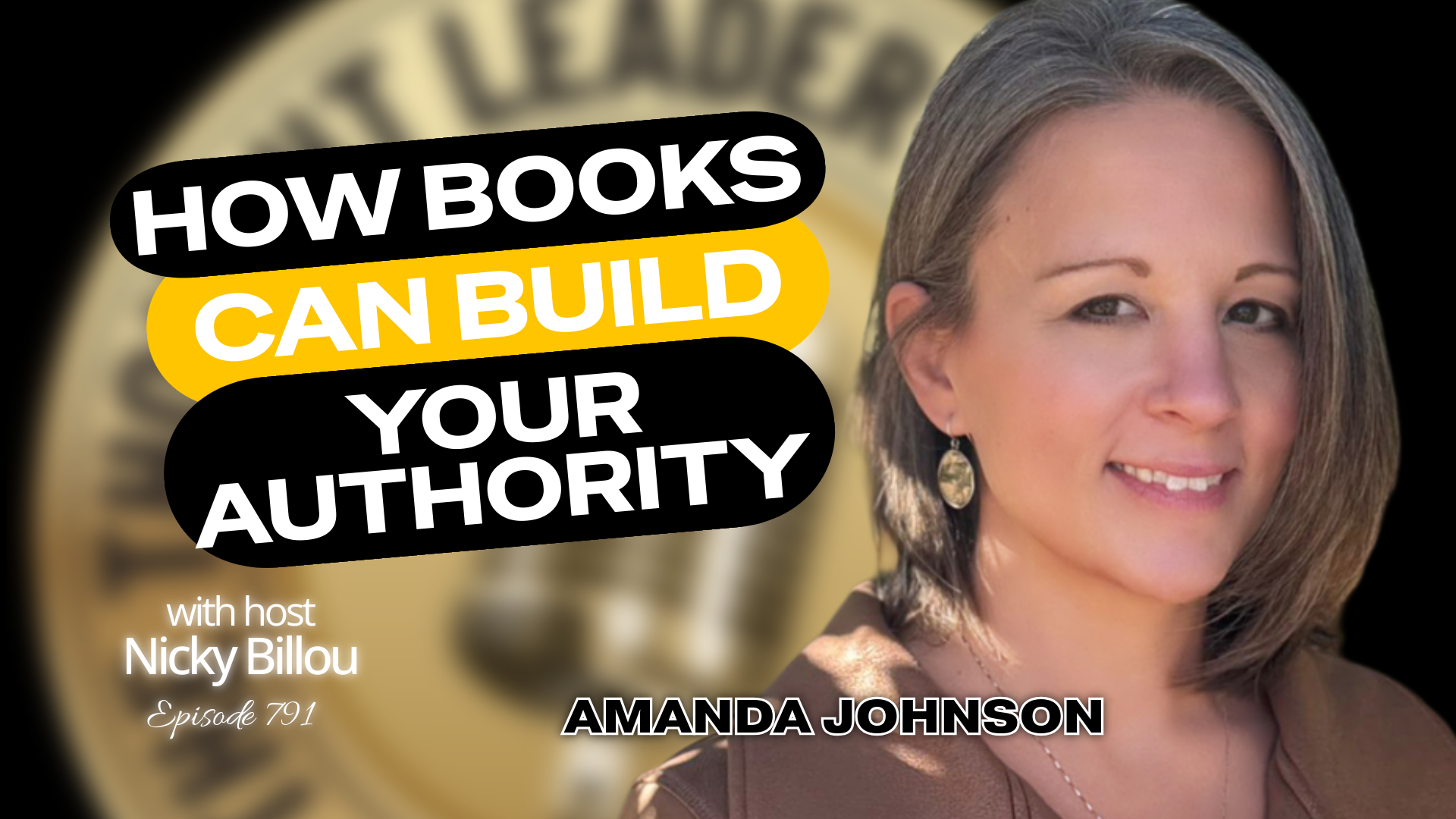
EP791: Amanda Johnson - How Books Can Build Your Authority
"What would be the use of me acquiring all of this for myself if I didn't leave it for somebody else?"
Most conversations about writing a book start in the same place: authority, credibility, speaking engagements, the business card that never gets thrown away. Amanda Johnson has spent 20 years in that conversation. But the insight that changed her work — and that shapes everything she does now — didn't come from a client who wanted to grow their brand. It came from a client who had 30 days to live.
Ruben was a business strategist, an empire builder, a man who had coached dozens of people in his image. When he was first diagnosed with cancer, he told Amanda he'd write his book after he beat it. He went into remission. Then the cancer came back, and they gave him a month. He called Amanda not to grieve but to get to work. He had three things left to do: hand over his business, marry his wife in a church, and finish the book. He wrote it in 30 days. He passed on day 31.
That story recalibrated what Amanda believes writing is actually for. Yes, a book puts a coach or consultant into a different tier of credibility — opens stages, closes clients, builds the kind of authority that a bio alone can't create. But beyond the business case, Amanda has found something else happening when accomplished people sit down to write. The blank page, unlike a live audience, gives nothing back. There's no room energy to read, no real-time feedback to ride. It's just the writer and their ideas — and that confrontation often reveals gaps in a framework the author didn't know were there, or stories they've been quietly carrying for years that still haven't been fully processed.
That's why giving clients a detailed chapter-by-chapter blueprint — what Amanda calls the message matrix — turned out not to be enough. The structure unlocked something, but many writers still couldn't move. They'd stall, miss emails, let the project drift. Amanda's answer was to kidnap them with consent. She created a retreat model, bringing clients together to write in community, with a witness. And that's when she saw it: for a certain type of high-achieving professional, especially those in the helping fields, there's often a piece of their story they've sealed off. They overcame something hard, moved on, and built something successful. But that sealed-off part is using energy — quietly holding them back from where they could go on stages, in their practice, in scaling. Writing, Amanda says, is one of the most powerful ways to release it. You let it come out through your hands, you look at it, and it no longer has the same grip.
Amanda Johnson is a writing coach and publisher known as The Story Oracle. She has spent over two decades helping thought leaders, coaches, and business owners find their core message, write with clarity, and bring books into the world that actually carry their voice. She founded Saved by Story House, a writing and publishing house for experts who are ready to leave something behind.
Amanda closes with three action steps for anyone who's been putting off the book:
1. Approach writing the way you've approached every other successful project in your business. You did not build what you've built without blocking time, developing a schedule, and putting protective boundaries around your work. The book deserves the same discipline. Treat it like a business priority, not a creative project you'll get to when things slow down.
2. Find a writing partner rather than a ghostwriter. A ghostwriter produces something efficient and often polished — but the energetic ownership of the work stays thin. When you write it yourself, even imperfectly, and have someone sharpen it, the book carries your fingerprints in a way that readers feel. Do as much of the writing as you can. Let someone else refine it.
3. Ask yourself honestly whether this book needs more time than you're used to giving a project. If there's a story calling to be told that still has weight when you think about it — sit with it. Find someone to witness it with you. Then put it into the world. Rushing past that story doesn't make it disappear. Processing it is often what makes the book powerful.
Learn more & connect:
Saved by Story House: https://www.savedbystory.house
Visit https://www.eCircleAcademy.com and book a success call with Nicky to take your practice to the next level.